
LLANRHIDIAN PRIMARY SCHOOL
Inspiring our learners to be the best they can be!
IQ - Caffi Cynefin
LO: To make decisions, considering the available information and the possible consequences.
Our delightful Caffi Cynefin has been serving up scrumptious treats for 4 whole years! But here's the burning question: How much do we really know about how our Caffi is run? Do the pupils know how we keep the caffi running? Can we make something to show profit/loss over the weeks we have been running? Can we make our Caffi more welcoming to help with this? Our Caffi's success is based on how we perform, so why not be the best we can be at every part of it!
I wonder, how much do we really know about our Caffi?
Activate your prior knowledge!
What do you think profit/loss means?
How well do we know the behind the scenes of the caffi? Are we welcoming to all countries and languages?
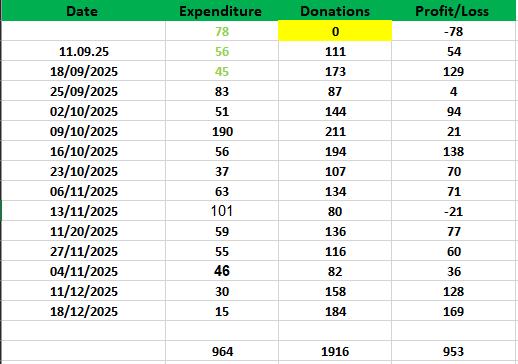
These are our real profit and loss margins for Autumn 2025.
1. Create a graph to show our profit and loss over Autumn 2025

Look at the table showing expenditure and donations for different dates.
-
Make a bar graph to show the donations for each date.
-
Put the dates on the x-axis.
-
Put the amount of donations on the y-axis.
-
Label your axes and give your graph a title.
-
Challenge: Which date had the highest donations?

The table shows expenditure and donations for different dates.
-
Create a double bar graph showing donations and expenditure for each date.
-
Use two different colours for the bars.
-
Label your axes and give your graph a title.
-
-
Answer these questions:
-
Which date had the biggest difference between donations and expenditure?
-
Which date had the lowest expenditure?
-

The table shows expenditure, donations, and profit/loss for different dates.
-
Create a line graph showing Profit/Loss for each date.
-
Use the dates on the x-axis and Profit/Loss on the y-axis.
-
Label your axes and give your graph a title.
-
-
Extension:
-
Add a second line to show Donations on the same graph.
-
What pattern do you notice between Donations and Profit/Loss?
-
Explain why the first date shows a negative profit/loss.
-
2. Beth hoffech chi fwyta a yfed yn Caffi Cynefin?
Hoffech chi fwyta...?
-
Brechdan – Sandwich
-
Cawl – Soup
-
Caws ar dost – Cheese toastie
-
Tatws pob – Jacket potato
-
Salad – Salad
-
Cacen – Cake
-
Bisged – Biscuit
-
Cacennau Cymreig – Welsh cakes
-
Sgôn – Scone
Hoffech chi yfed...? Would you like to drink?
-
Dŵr – Water
-
Llaeth – Milk
-
Sudd oren – Orange juice
-
Siocled poeth – Hot chocolate
-
Te – Tea
3. How can we divide food fairly across our Caffi?
Our café sold 4,500 biscuits last month.
-
How many biscuits would each customer get if we shared them equally between:
-
10 customers
-
100 customers
-
1,000 customers
-
(Hint: Use place value to divide by 10, 100, and 1,000.)
The café earned £84 from selling cakes. We want to share this money equally between 6 staff members.
-
Use partitioning to work out:
-
£84 ÷ 6
(Break £84 into tens and ones to help you.)
-
Challenge: If each staff member also gets £3 extra as a tip, how much do they get in total?
The café made £1,248 from drinks in December. We want to share this equally between 13 suppliers.
-
Use long division to calculate:
-
£1,248 ÷ 13
(Show your working using the formal written method.)
-
Extension: What is the remainder? How much more money would we need to make it a whole number for each supplier?
4.Create a villanelle poem that shows the power of Caffi Cynefin and what it does for the community.
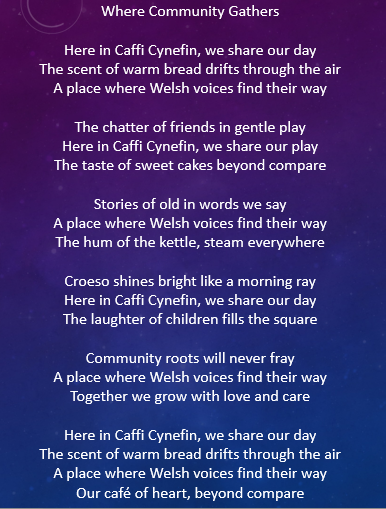
A villanelle is a poem, using two repeating lines and two rhymes.
Write a villanelle about Caffi Cynefin.
-
Start by writing two important ideas about our café (e.g., “It’s a friendly place” and “We love local food”).
-
Use these ideas as your repeating lines.
-
Make sure your poem shows what makes our Caffi special.
Tip: Think about words like community, Welsh culture, tasty food, friendship.
Write a 6 stanza villanelle about Caffi Cynefin that:
-
Uses two repeating lines about what the Caffi means to you.
-
Includes descriptive language (adjectives and senses: taste, smell, sound).
-
Shows why the Caffi is important for our community.
Challenge: Can you include a Welsh word or phrase (like croeso or cynefin) in your poem?
Create a 6 stanza villanelle about Caffi Cynefin.
-
Use two refrains (repeating lines) that capture the heart of the café.
-
Follow the rhyme scheme: ABA ABA ABA ABA ABA ABAA.
-
Include figurative language (similes, metaphors, personification) to show the café as a welcoming space for culture and community.
Extension: Explain why you chose your two repeating lines and how they represent Caffi Cynefin.
5. How would we greet someone to the Caffi who's first language is not English?
Question:
How would you greet someone at Caffi Cynefin if they do not speak English?
Sentence starters:
-
I would greet them by...
-
I could smile and say...
-
I could use my hands to...
Question:
What words or actions could you use to make someone feel welcome at Caffi Cynefin if English is not their first language?
Sentence starters:
-
I could use the word...
-
I could show them...
-
This would help because...
Question:
Why is it important to greet someone kindly and clearly at Caffi Cynefin if their first language is not English, and how does this show respect for their cynefin?
Sentence starters:
-
It is important because...
-
This shows respect by...
-
Cynefin means... so this helps by...

Create a new Caffi Cynefin logo. Remember to look at the previous ones in the Caffi to get ideas.
Hints:
- Use colouring pencils to create deep tone
- Avoid using words
- Make the images nice and large