
LLANRHIDIAN PRIMARY SCHOOL
Inspiring our learners to be the best they can be!
Arithmetic

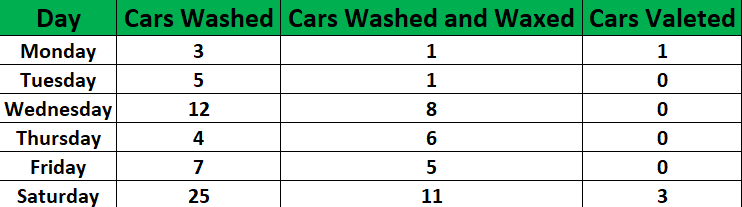
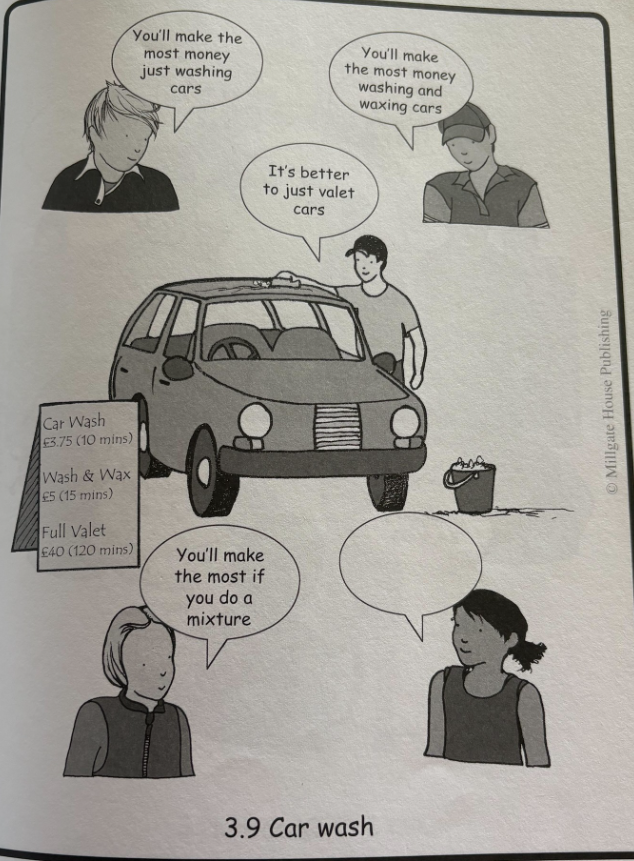
The car washer works 6 hours a day and needs to earn £550 a week to get a wage and cover all the business costs.
Does the business make any money?
Are there any problems with the chart?
What happens if the prices or the number of customers changes?

1. The car wash washes 18 cars in the morning and 27 cars in the afternoon. How many cars are washed all together?
2. Each car costs £5 to wash. How much money is made from washing 6 cars?
3. There are 4 wheels on each car. How many wheels are there on 8 cars?
4. The car wash has 24 sponges. They are shared equally between 6 buckets. How many sponges are in each bucket?
5. A customer pays with £10 for a £6 car wash. How much change should they get?

1. In one day, the car wash cleans 34 cars in the morning and 46 cars in the afternoon. How many cars are washed in total?
2. A basic wash costs £6. How much money is made from washing 15 cars?
3. There are 53 cars and each washer can clean 5 cars. How many full rounds can be completed? How many cars are left over?
4. Each car takes 12 minutes to wash. How long does it take to wash 5 cars?
5. A bucket holds enough water to wash 4 cars. How many buckets of water are needed to wash 23 cars? Explain your thinking.

1. A deluxe wash costs £7.50. How much do 8 deluxe washes cost altogether?
2. On Monday, 40 cars were washed. On Tuesday, this increases by 25%. How many cars are washed on Tuesday?
3. The car wash earns £428 in one day. There were 32 £6 washes and the rest were £8 washes. How many £8 washes were there?
4. The car wash opens at 9:15am. If 18 cars are washed and each takes 10 minutes, what time does the car wash finish?
5. A special offer gives 10% off a £9 wash. What is the new price? How much would 12 people pay altogether with the discount?

Create your own car wash price list and write 2 arithmetic questions.
LO: to add and subtract whole and decimal numbers using columns.

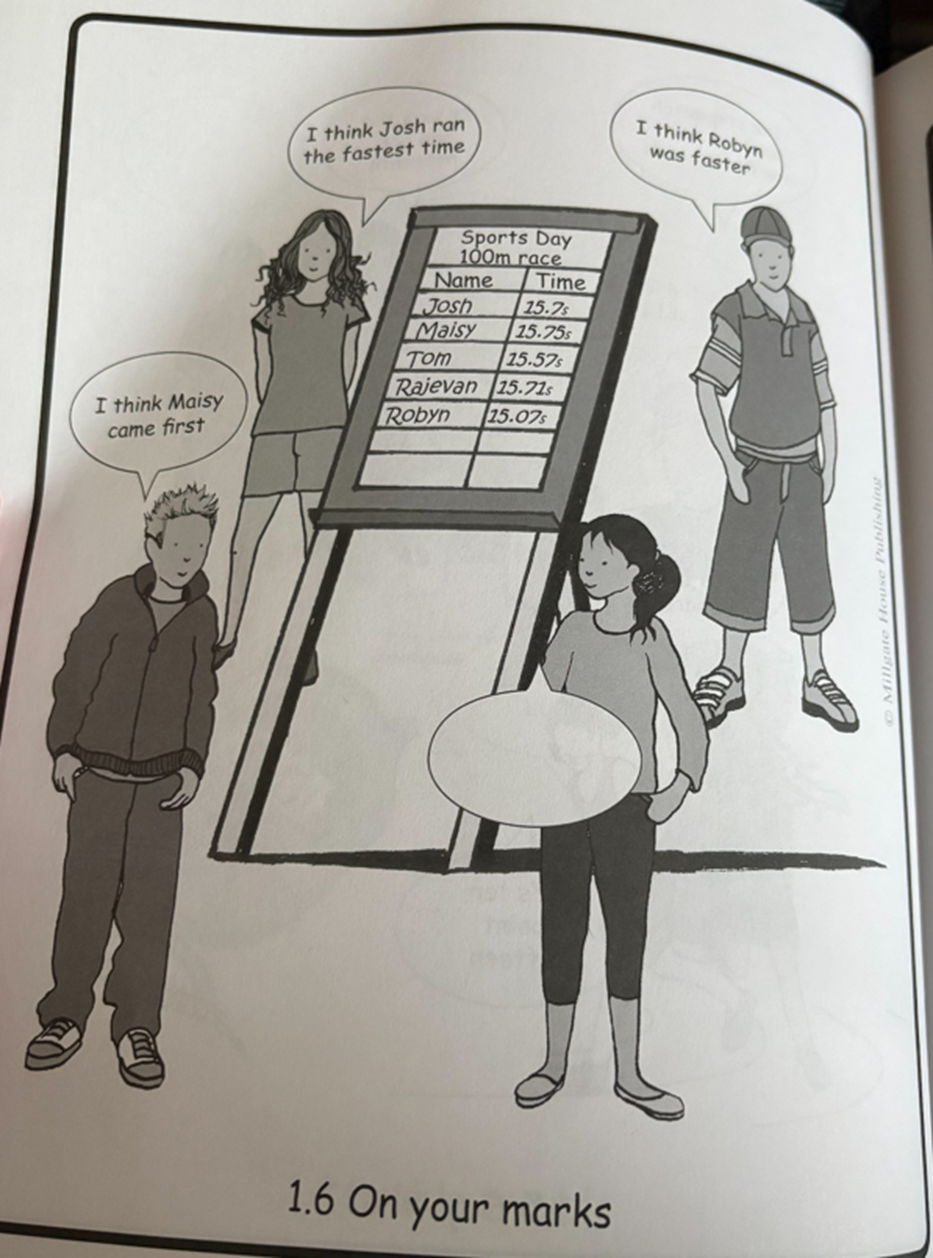
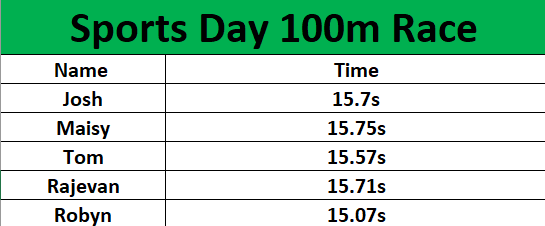
Which person is the fastest?
Which person is the slowest?
How do we know this?
What is the difference between the fastest and slowest times?
Q1 – Race Times
Four pupils ran a short race.
| Runner | Time (seconds) |
|---|---|
| A | 9.8 |
| B | 9.6 |
| C | 9.9 |
| D | 9.7 |
a) Who is the fastest?
b) Who is the slowest?
c) Put the times in order from fastest to slowest.
Q2 – Temperature
The temperatures at lunchtime were:
- Monday: 18.4°C
- Tuesday: 18.7°C
- Wednesday: 18.2°C
- Thursday: 18.9°C
a) Which day was the warmest?
b) Which day was the coolest?
Q3 – Weight
Four parcels were weighed.
- Parcel A: 2.3 kg
- Parcel B: 2.6 kg
- Parcel C: 2.4 kg
- Parcel D: 2.5 kg
a) Which parcel is the heaviest?
b) Which parcel is the lightest?
Q4 – Race Times
Three children ran 50 metres.
- Ben: 8.4 seconds
- Isla: 8.7 seconds
- Tom: 8.5 seconds
a) Who is the fastest?
b) Who is the slowest?
c) Explain how you used the tenths to decide.
Q1 – Race Times
A sprint final had these results:
| Athlete | Time (seconds) |
|---|---|
| Ella | 10.25 |
| Max | 10.32 |
| Sam | 10.21 |
| Noor | 10.28 |
a) Who is the fastest?
b) Who is the slowest?
c) Explain how you know using place value.
Q2 – Temperature
Overnight temperatures were recorded:
- Town A: −3.4°C
- Town B: −3.6°C
- Town C: −3.1°C
a) Which town was the coldest?
b) Which was the warmest?
Q3 – Weight
Three bags of rice weigh:
- Bag 1: 1.75 kg
- Bag 2: 1.7 kg
- Bag 3: 1.82 kg
a) Which bag is heaviest?
b) Which is lightest?
c) Order the weights from lightest to heaviest.
Q4 – Temperature Difference
The temperature in two cities was recorded:
- City A: 12.68°C
- City B: 12.45°C
a) Which city was warmer?
b) What is the difference in temperature between the two cities?
c) Which digit helped you decide most quickly?
Q1 – Race Times
Three runners completed a 100 m race.
| Runner | Time (seconds) |
|---|---|
| Leo | 9.876 |
| Maya | 9.842 |
| Alex | 9.861 |
a) Who is the fastest?
b) Who is the slowest?
c) Put the runners in order from fastest to slowest.
Q2 – Difference in Race Times
Maya ran in 9.842 seconds and Alex ran in 9.861 seconds.
a) How much faster was Maya than Alex?
b) Show your working using column subtraction.
Q3 – Temperature Change
The temperature at midnight was −1.375°C
By morning it was 0.426°C
a) How much did the temperature increase?
b) Was the change more or less than 2°C? Explain.
Q4 – Weight Comparison
Two suitcases weigh:
- Suitcase A: 23.458 kg
- Suitcase B: 23.405 kg
a) Which suitcase is heavier?
b) What is the difference in weight?
c) How do the thousandths digits help you decide?
Q5 – Weight Difference
Two science samples were weighed very carefully.
- Sample A: 4.237 kg
- Sample B: 4.291 kg
a) Which sample is heavier?
b) What is the difference in weight?
c) Why is looking at the thousandths digit important in this question?