
LLANRHIDIAN PRIMARY SCHOOL
Inspiring our learners to be the best they can be!
Llythrennedd
L.O: To use time connectives to sequence instructions clearly.
Success criteria
- I can put actions in a logical order.
- I can choose suitable time connectives.
- I can help a reader know what to do first, next and last.
Learn
Let's think about packing a backpack to explore the Arctic like April, in The Last Bear.
Pack your warm coat.
Put your map in the backpack.
Which needs to happen first?
How can we show the reader the order?
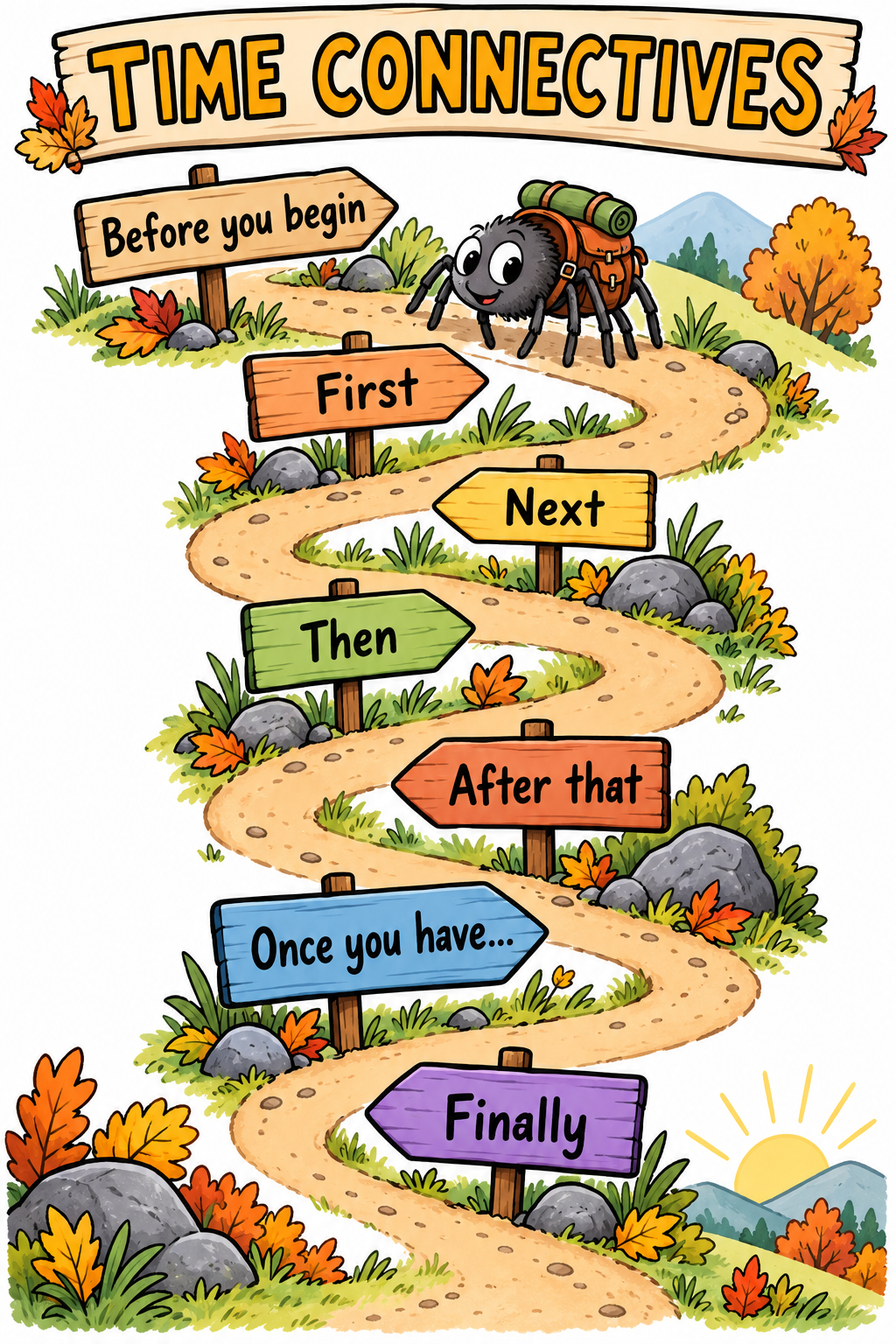
let's put these into the sentences to help the reader follow the instructions in the correct order.
Understand
In pairs, sort these muddled Arctic-explorer steps:
-
Pack a waterproof coat and warm gloves.
-
Check that your backpack is securely closed.
-
Put a map and compass in the front pocket.
-
Choose a strong, empty backpack.
-
Add a torch, water bottle and emergency snack.
-
Place a first-aid kit near the top of the bag.
Your task:
-
Put the steps into the most logical order.
-
Add a suitable time connective to each.
-
Be ready to justify one choice: “We put this step first because…”
Apply
Arctic Explorer Backpack Challenge
Imagine you are helping April prepare to explore Bear Island. April will rely on your instructions to pack everything she needs safely and in the correct order.
Write a set of instructions and use your knowledge of time connectives to guide your reader through each step.
Think carefully:
-
What must happen first?
-
Which equipment needs to be easy to reach?
-
Have you used clear bossy verbs?
-
Will your instructions help the explorer pack independently?
First, ____________________________.
Next, ____________________________.
Then, ____________________________.
After that, ________________________.
Finally, __________________________.
L.O : I can use different sentence types to engage my reader.
Today, you will learn how writers use different sentence types to make the beginning of their instructions interesting and clear.
A strong introduction can include:
-
a rhetorical question to make the reader think;
-
a statement explaining what the reader will make or do;
-
a sentence explaining why the instructions are useful.
For example:
Would you like to help local wildlife?
Follow these instructions to make a simple bug hotel.
It will give minibeasts a safe place to hide.
First, work with a partner to improve some weak introductions. Think carefully about how you can make the reader interested and give them useful information.
Now, write your own short introduction for different sets of instructions. Use the images to creatively think about what the instructions could be for!

What are the instructions for?
Who might use them?
Why would they be useful?
Write an engaging introduction using a rhetorical question and clear statements.
Aim for two or three sentences, using the success criteria to help you write an engaging introduction.
Success Criteria
I have used a rhetorical question to engage my reader.
I have used a statement to explain what the reader will make or do.
I have explained why the instructions are useful.
I have used a question mark correctly.
Challenge
Can you make your rhetorical question more purposeful and varied, rather than relying on 'Would you like to... ?'
-
Have you ever wondered how...?
-
What better way to help local wildlife than...?
-
Could your garden become a safer place for...?
-
How could one simple creation make a difference to...?


